
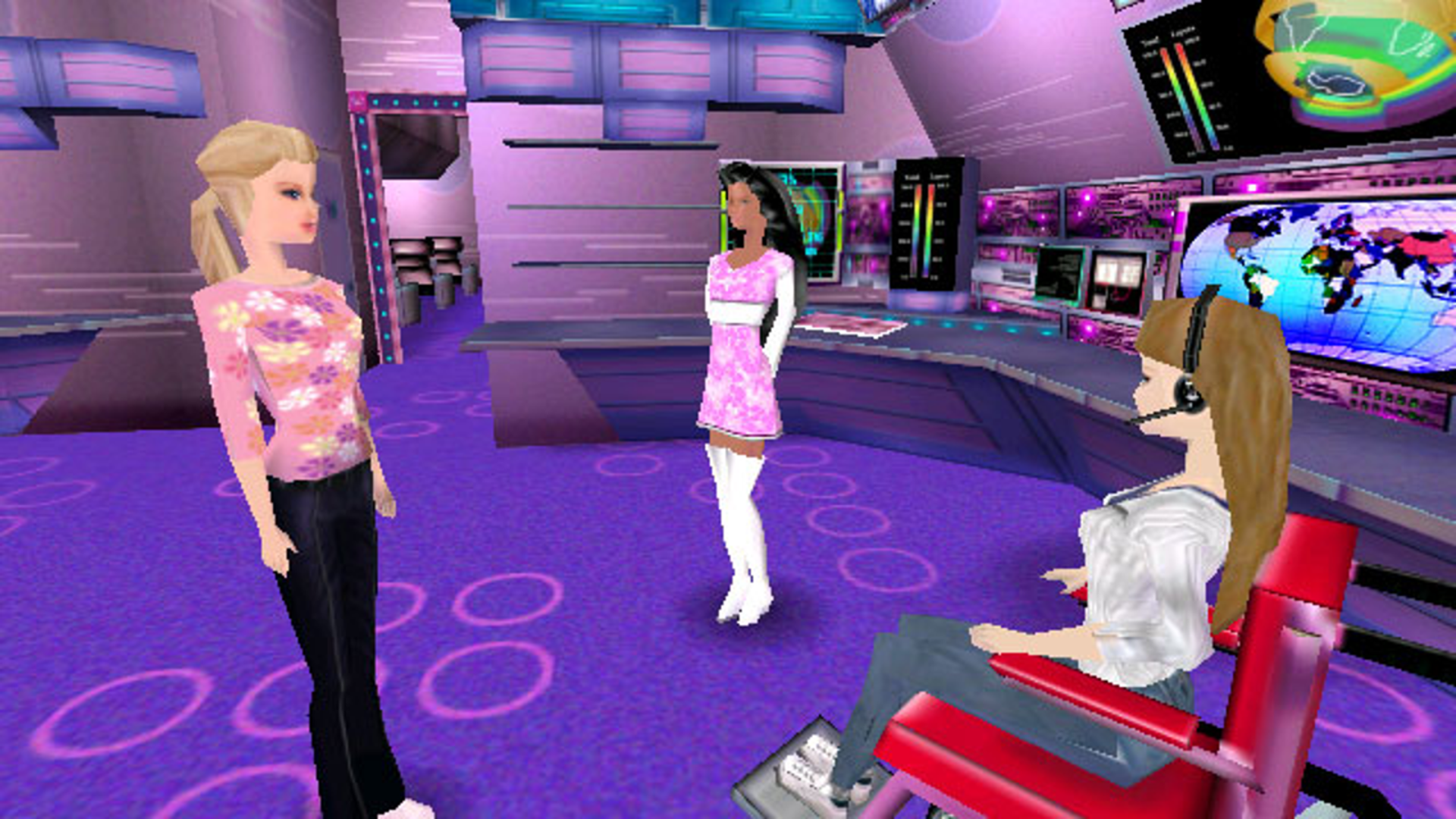
I’m just going to come right out and say it: I don’t do spies. To me, there is nothing more insufferable than someone who can’t even tell you what their job is. I feel the exact same way about people who work at Deloitte, but since we don’t yet have Risk Management Simulator (I wonder why, you monotonous shitheels), I revisited the classic Metal Gear Solid-like action-platformer Barbie: Secret Agent to see whether I’d like a spy protagonist more if she were an infinitely employable white woman – and, you know what? I did. That is, apart from the completely unnecessary MKULTRA subplot. I’ll explain.
The game centres on you, Barbie, tracking down Camille, a thief who stole the Queen’s Jewels. Despite my strong anti-monarchy misgivings, and the knowledge that those jewels probably actually belonged somewhere in India, I enjoyed seeing Barbie through some lightly-challenging jumping, dodging and stealthing, picking locks and unscrambling codes as I tracked Camille across England, China, Italy and eventually Mexico. But here was where the game became something entirely different. Something I didn’t love.
Upon apprehending the notorious jewel thief, she is captured and taken into custody via a kid-friendly fade to black. When the picture is restored, we see Barbie and her captive in a dank basement somewhere below the Stanford University campus. Camille, bound to a chair, looks weary and disheveled, although a beatific smile plays across her face as she begins to hallucinate to a Grateful Dead record piped in from a nearby phonograph. Barbie, meanwhile, stands watching, steepling her fingers in cold satisfaction. The text reads:
BARBIE: Say it again.
CAMILLE: I am pure of heart and mind. I am a servant. I am an American.
The game ends there, and we are led to believe that this was the goal all along: turn this rogue Frenchwoman into a mindlessly loyal CIA operative. That we were torturing the French did not give me pause for one second – French people didn’t achieve rights in gaming until they busted out of that creepy-ass painting and learned to parry incoming mime attacks – but the fact we were torturing at all felt really out of place. That just wasn’t what this game was, in my opinion. Had they actually taken the time to weave in the threat of Communism before having, say, Ken tell me that the Soviet Union was an enemy of democracy, this subplot would have at least felt earned.
Perhaps I shouldn’t have been so shocked. Looking back, there were a few subtle hints that we were going to end up here. During a reconnaissance mission aboard a luxury yacht in Italy, Barbie idly questions a sunbathing Theresa:
BARBIE: Theresa, my dear, do you believe in the strength of the human personality? Or may we unravel the psyche through the power of mere suggestion? Might a man of principles and conviction be reduced to a salivating mess beneath the swing of a hypnotist’s pendulum?
THERESA: I love lemonade!
The game isn’t bad. It’s well-presented and eminently playable, even twenty-five years after its release, and I think kids and adults alike would get a kick out of it. I just wasn’t feeling the mind-control twist, was all. And before you go on about not being able to enjoy things any more because of Woke, I ask you this: when you order a burger, do you expect there to be a tab of LSD nestled between the lettuce and bun? Wouldn’t it spoil your fun if your birthday cake was laced with mescaline and your gift was a polygraph test? My point is, some surprises are welcome. But if I’m committing an egregious human rights violation, I want to know about it well in advance.





Leave a Reply